

The Construction of Perception
From Romantic Sublimity to Impressionist Immediacy
Art History | Spring 2026
Hollins University | ART 250: Introduction to Art History
10 May 2026
-
This paper examines how J.M.W. Turner’s The Slave Ship (1840) and Claude Monet’s Impression, Sunrise (1872) reveal the shift from Romanticism to Impressionism through their contrasting approaches to light, color, and atmosphere. Addressing the problem of how two visually similar seascapes employing loose brushwork and an emphasis on sensory experience can produce fundamentally different effects, this student argues that the transition between these movements reflects a deeper transformation in the construction of perception rather than a purely stylistic change. Using formal analysis alongside a phenomenological framework informed by psychoanalytic theory, this paper demonstrates that Turner constructs an overwhelming, emotionally charged visual experience rooted in the Romantic sublime and moral narrative, shaped in part by the historical context of the Zong Massacre, while Monet presents perception as immediate, detached, and centered on fleeting visual sensation, as seen in his work’s association with the First Impressionist Exhibition. Through close comparison, Turner’s turbulent composition, saturated reds and oranges, and obscured forms evoke chaos, violence, and psychological intensity, whereas Monet’s muted palette, softer brushwork, and dissolving forms create a calm, contemplative atmosphere focused on the transient effects of light in the port of Le Havre. Ultimately, this paper concludes that the shift from Romanticism to Impressionism marks a fundamental change in artistic intention, moving away from emotional and symbolic representation toward the direct, momentary experience of the visual world.
The Art That Is Researched
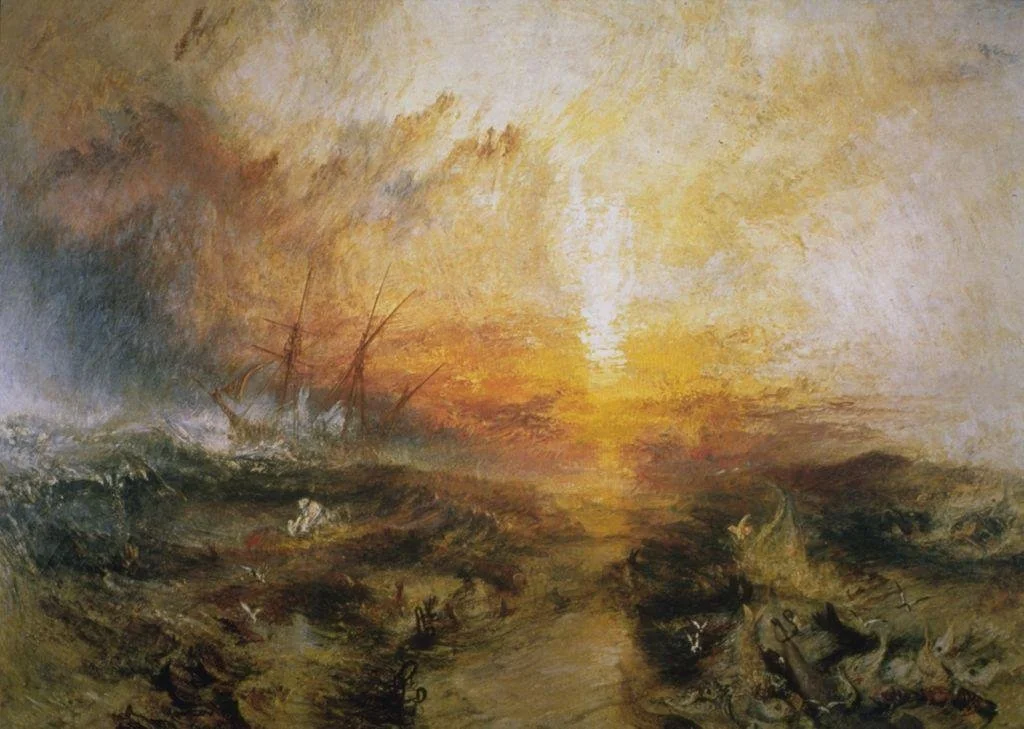
Figure 1. Joseph Mallord William Turner, The Slave Ship (Slavers Throwing Overboard the Dead and Dying, Typhoon Coming On), 1840. Oil on canvas, 35 ¾ x 48 ¼ in. (90.8 × 122.6 cm).
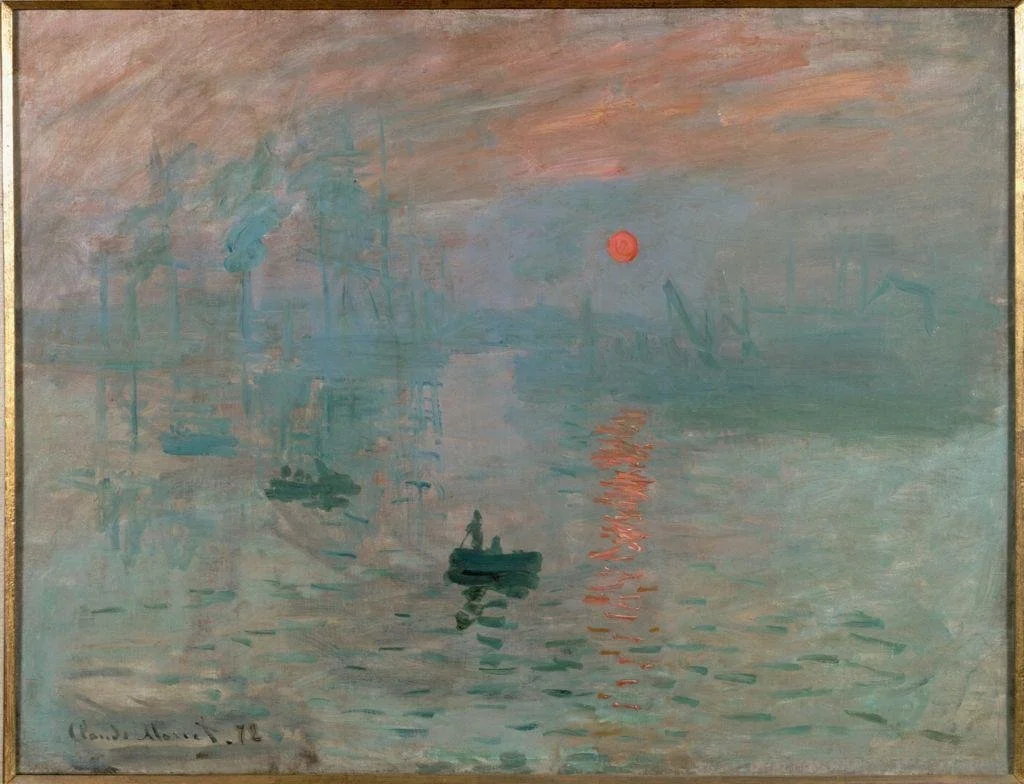
Figure 2. Claude Monet, Impression, Sunrise, 1872. Oil on canvas, 18.9 × 24.8in. (48 × 63 cm). Musée Marmottan Monet, Paris.
The Construction of Perception, a presentation.
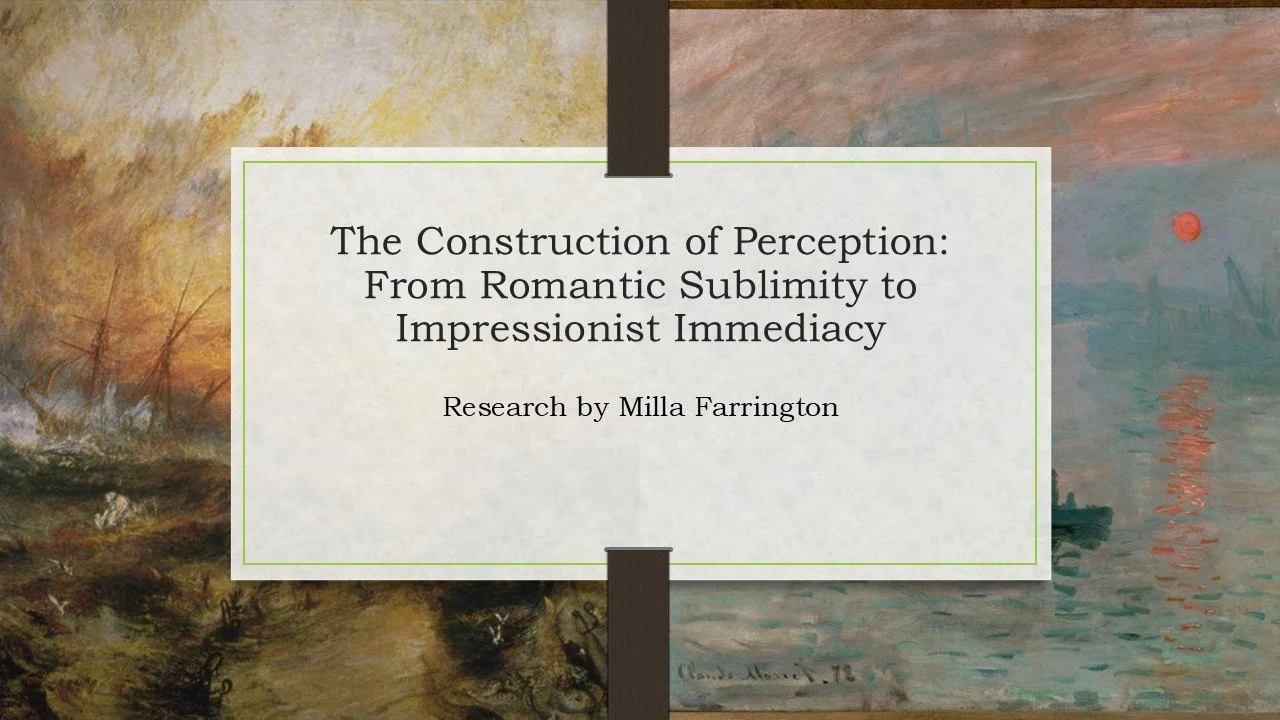
Examining how The Slave Ship (1840) and Impression, Sunrise (1872) reveal the shift from Romanticism to Impressionism through their contrasting approaches to light, color, and atmosphere.
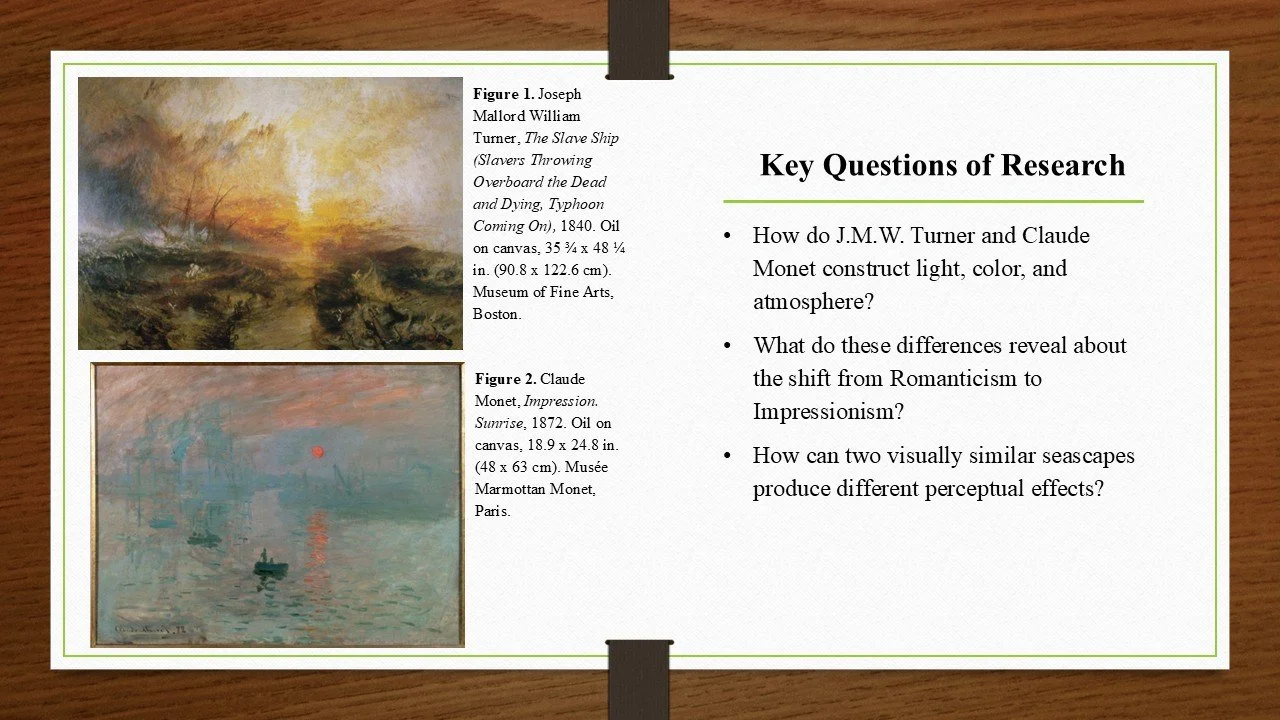
It was not simply a stylistic change, but a deeper transformation in the construction of perception itself.
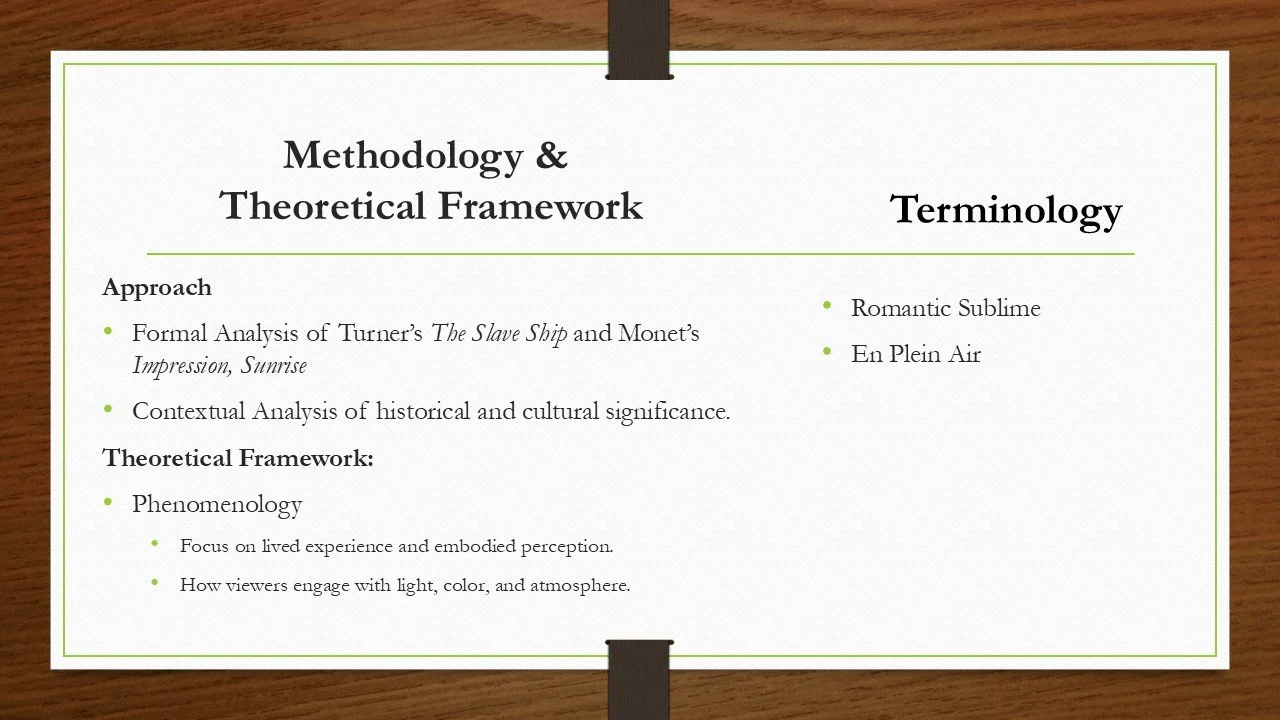
Phenomenology emphasizes lived, embodied experience— how viewers encounter artworks through light, color, and texture.
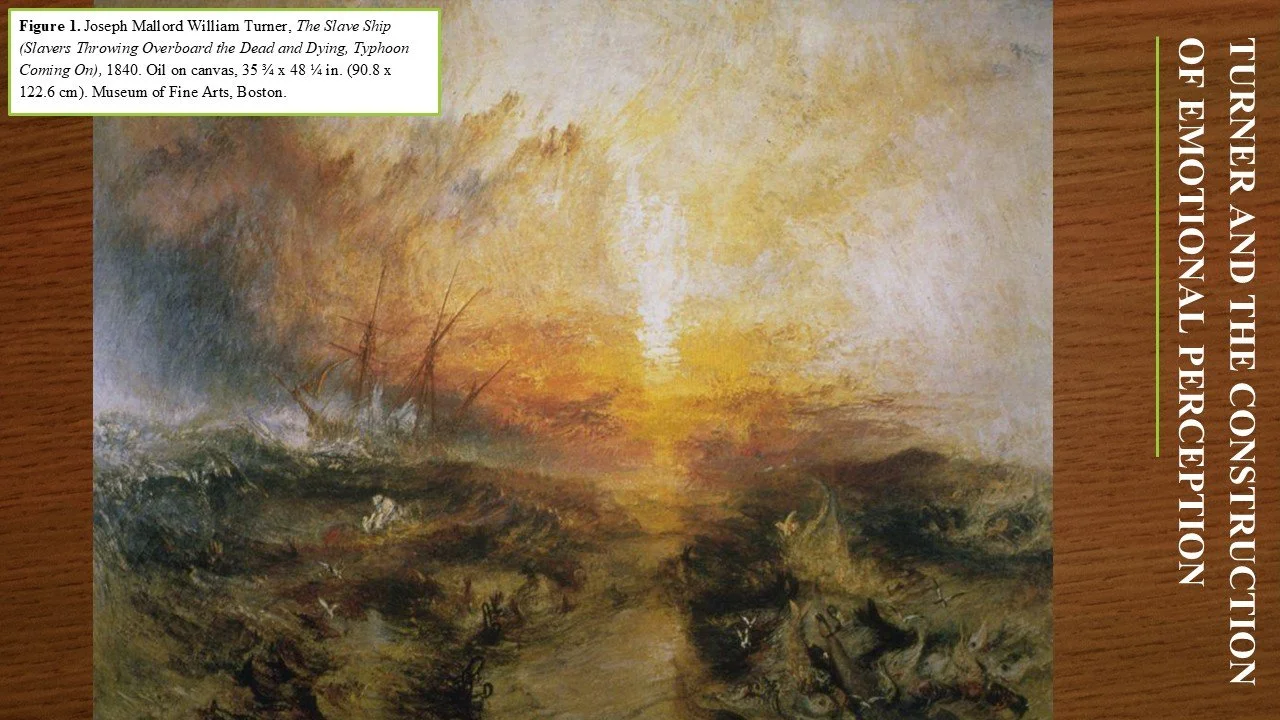
J.M.W. Turner’s 1840 painting The Slave Ship, depicting a stormy sea with enslaved people thrown overboard, alongside a textbook page about emotional perception.
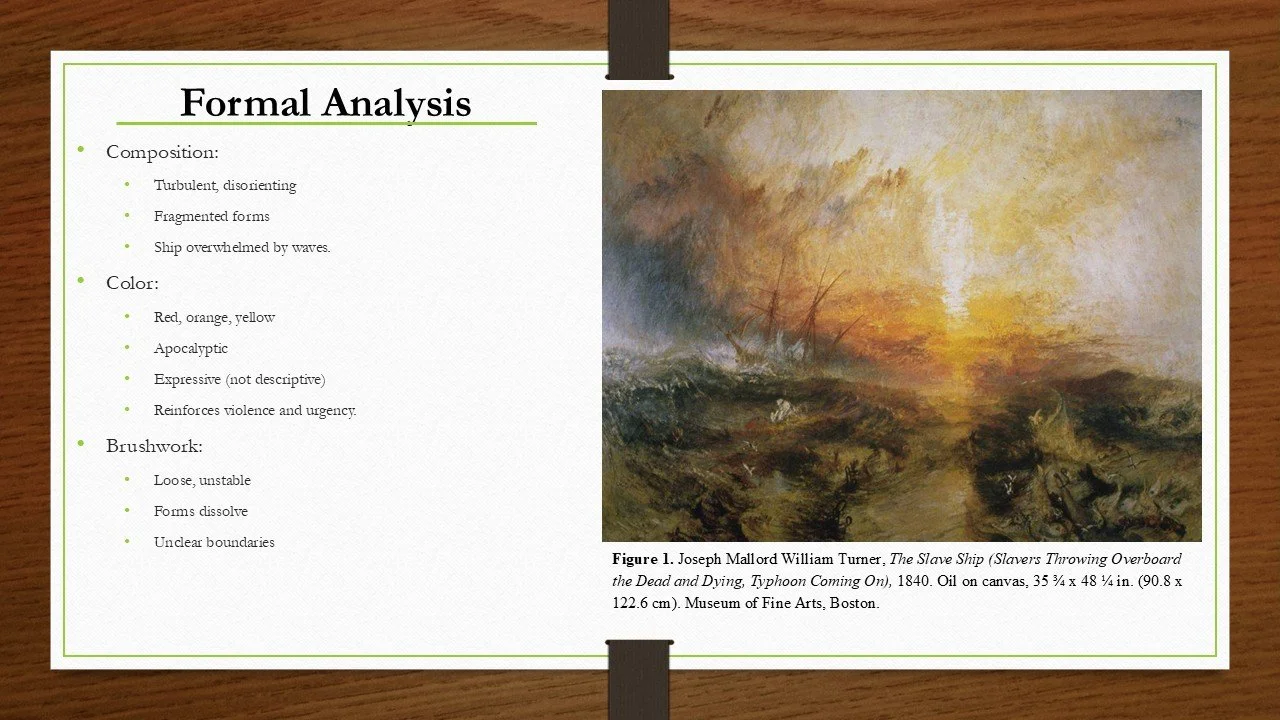
The composition resists clarity, and its instability forces the viewer into a strained and uncomfortable act of looking. Color and brushwork also play significant roles within The Slave Ship to show that perception itself is unstable.
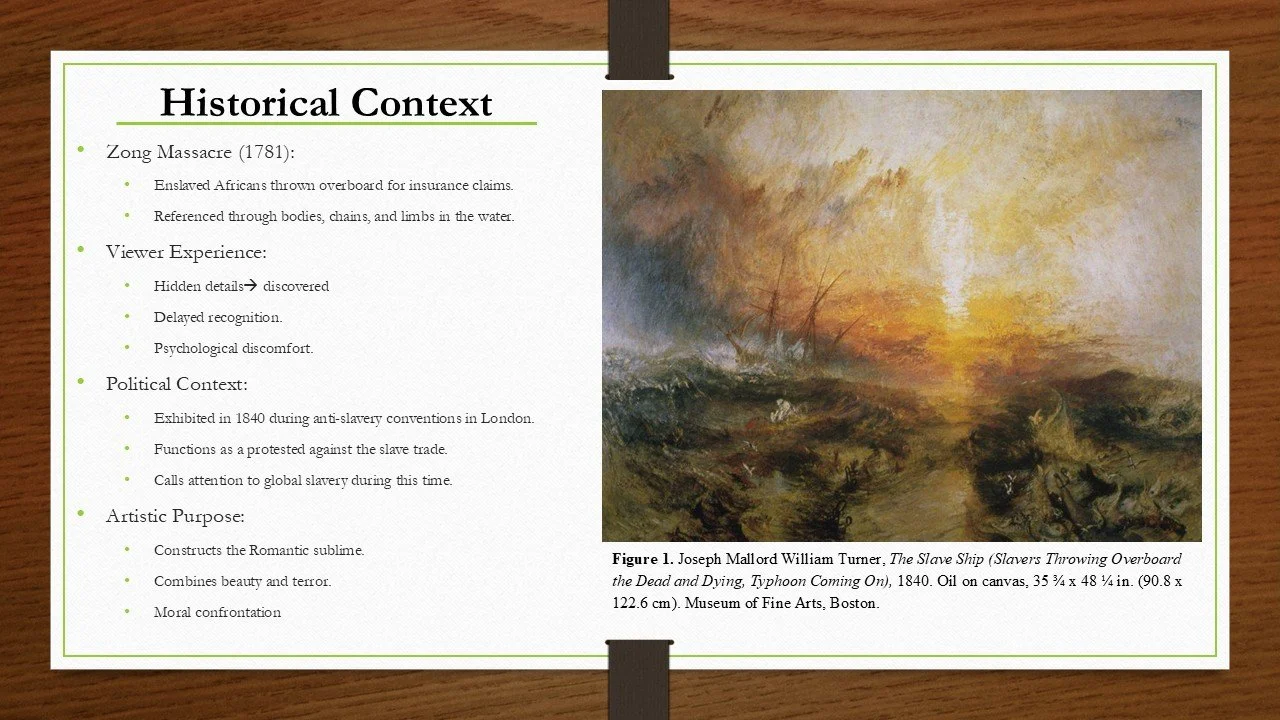
The Slave Ship references the Zong Massacre, however the details must be discovered before they are visible. Delayed recognition gives way to psychological discomfort, forcing the viewer into an active and uneasy engagement with the scene. Light, color, and atmosphere do not simply depict nature, they construct the Romantic sublime.
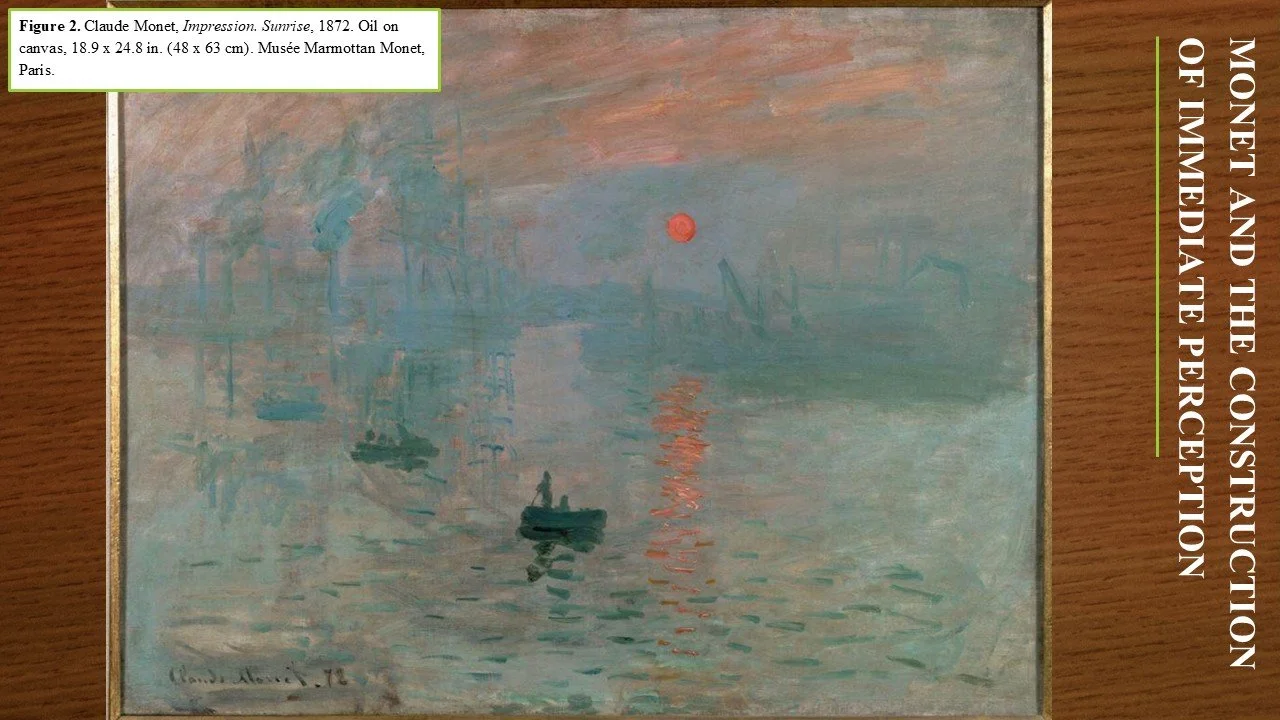
Claude Monet's 1872 Impression, Sunrise, depicting boats on misty harbor water beneath a red-orange sun; captioned museum artwork.
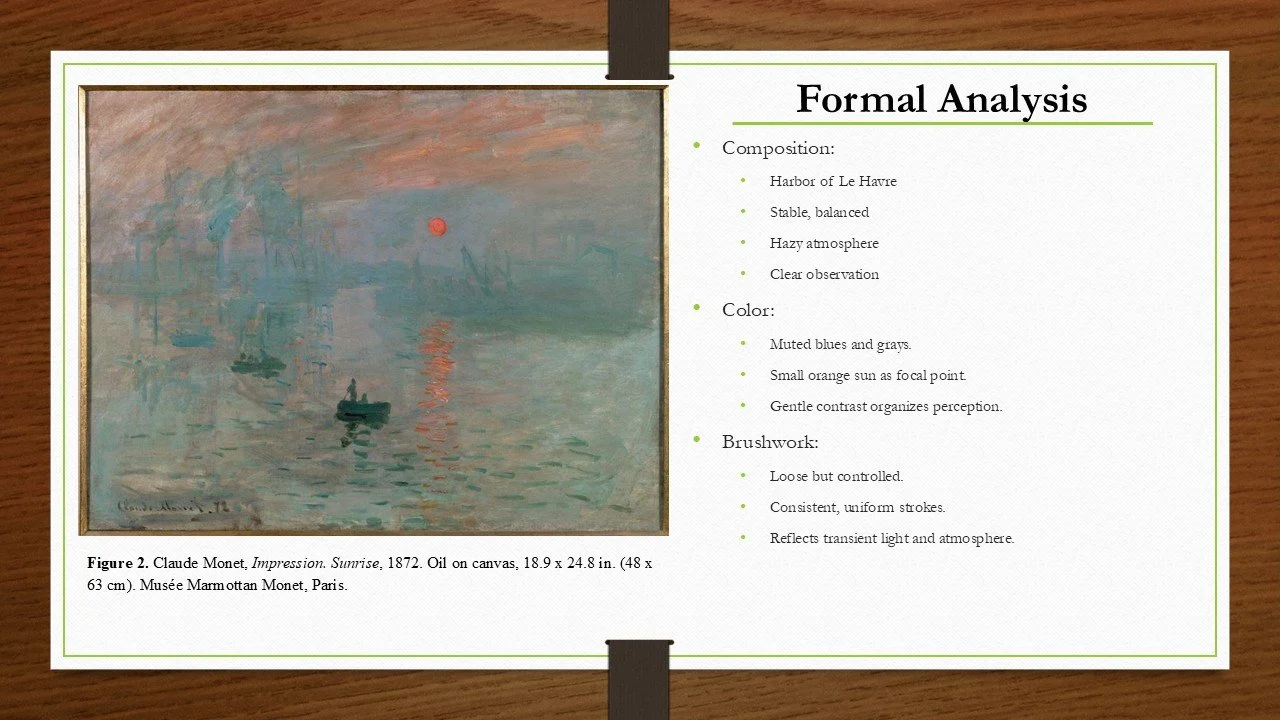
The composition is that of the harbor of Le Havre, with restrained colors dominated by muted blues and grays with only the small orange sun providing contrast. The perception here is invited, stable, yet detached.
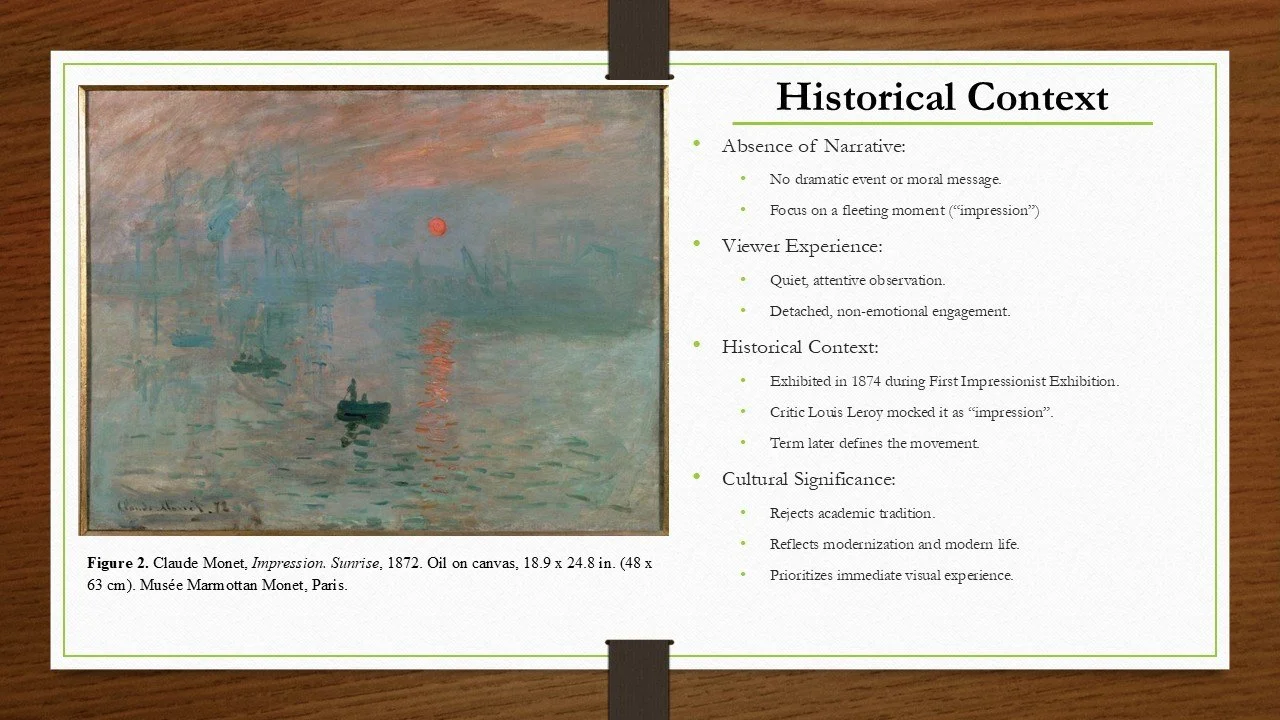
Monet removes the narrative entirely that the Romantic sublime intentionally relied upon. There is no dramatic event, no moral message to be told. It only captures a fleeting moment, an impression. Perception itself is the only subject of Impression, Sunrise.
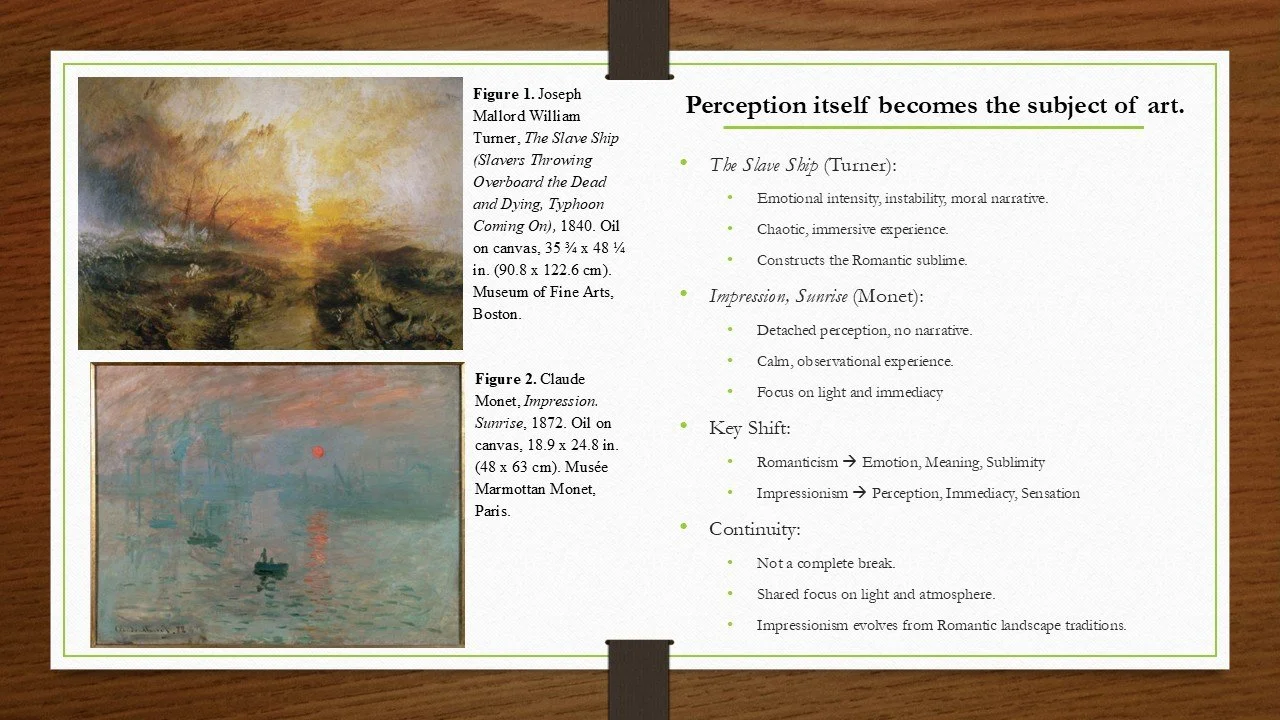
Comparing these works reveals a fundamental transformation in how perception is constructed. Turner engages the viewer through emotional intensity, instability, and moral narrative. Monet, by contrast, simplifies perception. He removes narrative and emotional excess, focusing instead on light, atmosphere, and immediacy. This shift represents the movement from Romantic sublimity to Impressionist immediacy overall.
Bibliography
Barasch, Moshe. “5 | Impressionism: Reflections on Style.” In Modern Theories of Art 2: From Impressionism to Kandinsky. NYU Press, 1998. https://www.jstor.org/stable/j.ctt9qgfz.9.
Blayney Brown, David, and Amy Comcannon. J.M.W. Turner: Painting Set Free. Edited by Sam Smiles, David Blayney Brown, and Amy Comcannon. With J.M.W. Turner. The J. Paul Getty Museum, 2014.
Boime, Albert. Art and the French Commune: Imagining Paris after War and Revolution. Princeton University Press, 1995. Xiv, 234 p. :ill, maps; 27 cm.
Brion, Marcel. Art of the Romantic Era; Romanticism, Classicism, Realism. Praeger, 1966.
Claude, Monet and Metropolitan Museum of Art. Monet’s Years at Giverny: Beyond Impressionism. Metropolitan Museum of Art, 1978. https://libmma.contentdm.oclc.org/digital/collection/p15324coll10/id/85352.
Dempsey, Amy. Styles, Schools, and Movements: The Essential Encyclopedic Guide to Modern Art. Thames and Hudson, 2006.
Dixon, Lucina War, and Niki Van Der Heuvel. Turner to Monet: The Triumph of Landscape. Artonview. 2008.
George-Philips, Kalea. “Impression, Sunrise: The Evolution of Late 19th Century and Early 20th Century French Landscapes.” Undergraduate Thesis, Trinity College, 2025, https://www.jstor.org/stable/community.39591099?seq=1.
Grueb, Suzanne. Towards Impressionism: Landscape Painting from Corot to Monet. Translated by David Radzinowicz. Cornell Fine Arts Museum, 2017.
Haywood, Ian, Susan Matthews, and Mary L. Shannon. Romanticism and Illustration. Cambridge University Press, 2019.
Lindsay, Jack. J.M.W. Turner: His Life and Work; A Critical Biography. New York Graphic Society, 1966.
Nochlin, Linda. Impressionism and Post-Impressionism, 1874-1904; Sources and Documents. Englewood Cliffs, N.J., Prentice-Hall, 1966. Ix, 222 p. facsim. 23 cm.
Phillips, Jr., Duncan C. “What Is Impressionism?” Art and Progress 3, no. 11 (1912): 702-7.
Seitz, William C. Claude Monet. Abrams, 1983.
Seitz, William C. “Monet and Abstract Painting.” College Art Journal 16, no. 1 (1956): 34-46.
Shanes, Eric. The Masterworks of J.M.W. Turner. Parkstone International, 2004.
Smith, Paul. Impressionism: Beneath the Surface. Harry N. Abrams, Inc., 1995. 176 p. : ill. (chiefly col.) ; 24 cm.
Snider, Lindsay. “A Lasting Impression: French Painters Revolutionize the Art World.” The History Teacher 35, no. 1 (2001): 89-102.
Tinterow, Gary, Henri Loyrette, Grand Palais, and Metropolitan Museum of Art. Origins of Impressionism. Metropolitan Museum of Art, 1994. Xvi, 486 p. :ill. (some col.); 32 cm.
Vaughan, William. “Romanticism.” Grove Art Online, n.d. https://www.oxfordartonline.com/groveart/display/10.1093/gao/9781884446054.001.0001/oao-9781884446054-e-7000073207.
Venturi, Lionello. “The Aesthetic Idea of Impressionism.” The Journal of Aesthetics and Art Criticism 1, no. 1 (1941). https://www.jstor.org/stable/426742?origin=crossref&seq=8.
Zinn Education Project: teaching People’s History. Nov. 29, 1871: Zong Massacre. n.d. https://www.zinnedproject.org/news/tdih/zong-massacre/.
Continue the Conversation
Interested in reading the full research paper or learning more about this project? You’re welcome to get in touch.
Keep Exploring: Art History
Return to the research archive to explore more works, questions, and visual analyses.